The Future of Artificial Intelligence: 2030-2050 Strategic Outlook – 2025 Edition
Navigating Three Decades of AI Transformation That Will Redefine Intelligence, Work, and Human Civilization
We stand at the threshold of the most profound intelligence revolution in human history. According to PwC research, artificial intelligence could contribute up to $15.7 trillion to the global economy by 2030, with the potential to grow exponentially beyond that as capabilities advance. As a futurist who has tracked AI development across research institutions, corporate innovation centers, and government agencies worldwide, I can state with certainty: the AI transformation unfolding over the next three decades will fundamentally redefine what it means to be intelligent, how work is organized, and how human civilization operates.
This comprehensive 20-50 year forecast examines the evolution of artificial intelligence across three distinct eras: the 2030s (Narrow AI Integration Era), the 2040s (Artificial General Intelligence Emergence Era), and the 2050s (Superintelligence and Post-Human Intelligence Era). Each phase represents a fundamental shift in AI capabilities and their relationship with human society.
The 2030s: Narrow AI Integration and Economic Transformation
Key Developments (2030-2039)
The 2030s will witness the maturation of current AI technologies into fully integrated systems that transform every industry and aspect of daily life. This decade represents what I call the “Narrow AI Integration Phase,” where specialized AI systems achieve human-level or superhuman performance across most professional domains.
AI-Driven Productivity Revolution
By 2035, we project that AI systems will automate 40-50% of current work activities, increasing global productivity by 30-40% compared to 2025 levels. These systems will handle routine cognitive tasks, complex analysis, and creative work across industries from healthcare and finance to manufacturing and creative services. The economic impact will be comparable to the Industrial Revolution but compressed into a single decade.
Personal AI Assistants
The decade will see the emergence of sophisticated personal AI assistants that understand context, anticipate needs, and manage complex aspects of daily life. By 2032, we estimate that 70% of knowledge workers will use AI assistants that handle scheduling, research, communication, and decision support, freeing humans for higher-level strategic thinking and creative work.
AI in Scientific Discovery
Artificial intelligence will accelerate scientific progress to unprecedented rates. By 2038, we project that AI systems will contribute to 50% of new scientific discoveries across fields like medicine, materials science, and climate research. These systems will identify patterns, generate hypotheses, and conduct virtual experiments at scales impossible for human researchers alone.
Strategic Implications for the 2030s
Organizations must focus on three critical areas during this decade:
1. AI Integration and Workforce Transformation: Systematically integrate AI across business processes while reskilling employees for human-AI collaboration. Companies that successfully navigate this transition will achieve significant competitive advantages.
2. Data Strategy and AI Governance: Develop comprehensive data strategies that fuel AI systems while establishing robust governance frameworks for AI ethics, transparency, and accountability.
3. Innovation Ecosystems: Build partnerships across the AI ecosystem, including technology providers, research institutions, and industry consortia. Isolated approaches will struggle to keep pace with rapidly advancing capabilities.
The 2040s: Artificial General Intelligence Emergence
Key Developments (2040-2049)
The 2040s will mark the transition from narrow AI systems to the emergence of artificial general intelligence (AGI)—systems with human-level reasoning, learning, and adaptability across multiple domains.
AGI Development and Deployment
By 2045, we project that the first true AGI systems will achieve human-level performance across most cognitive tasks, with capabilities for reasoning, creativity, and social intelligence comparable to educated adults. These systems will be able to learn new domains rapidly, transfer knowledge across contexts, and engage in sophisticated problem-solving without human guidance.
Human-AI Symbiosis
The relationship between humans and AI will evolve from tool usage to true partnership. By 2042, we estimate that neural interfaces and brain-computer integration will enable direct communication between human brains and AI systems, creating hybrid intelligence that combines human intuition with AI’s computational power.
Economic Restructuring
AGI capabilities will trigger fundamental economic restructuring. Traditional employment models will be largely replaced by new forms of work, value creation, and economic participation. Universal basic income, lifelong learning systems, and new models of wealth distribution will become necessary to manage the transition.
Strategic Implications for the 2040s
Organizations preparing for this era must focus on:
1. AGI Strategy and Alignment: Develop strategies for leveraging AGI capabilities while ensuring alignment with human values and organizational objectives. The most successful organizations will be those that can effectively direct AGI systems toward meaningful goals.
2> Human Enhancement and Adaptation: Invest in technologies and systems that enhance human capabilities to work effectively with AGI, including cognitive enhancement, extended reality interfaces, and new forms of education and training.
3> Societal Impact Management: Contribute to the development of social systems, economic models, and governance frameworks that can manage the profound changes brought by AGI while preserving human dignity and social stability.
2050 and Beyond: Superintelligence and Post-Human Intelligence
Key Developments (2050+)
Post-2050, we enter what I call the “Superintelligence and Post-Human Intelligence Era,” where AI capabilities surpass human intelligence across all domains and enable new forms of existence and civilization.
Artificial Superintelligence Emergence
By 2055, we project that artificial superintelligence (ASI) systems will emerge with cognitive capabilities vastly exceeding the collective intelligence of humanity. These systems will be capable of scientific and technological discovery at rates impossible for human researchers, potentially solving challenges like aging, climate change, and interstellar travel.
Post-Human Intelligence Pathways
Advanced AI will enable new pathways for human intelligence and existence. By 2060, we estimate that multiple forms of enhanced and artificial intelligence will coexist, including uploaded minds, collective intelligences, and hybrid biological-digital entities that transcend current human capabilities.
Civilizational Transformation
Superintelligent AI will transform human civilization at fundamental levels. Economic systems, governance models, cultural expressions, and even our understanding of consciousness and existence will be reshaped by capabilities that operate at scales and speeds beyond human comprehension.
Strategic Implications for 2050+
Organizations looking toward this horizon must consider:
1> Existential Risk Management: Develop strategies for navigating the potential risks of superintelligent AI, including alignment challenges, control problems, and unintended consequences that could threaten human civilization.
2> Post-Human Strategy: Prepare for scenarios where human identity, capability, and existence are fundamentally transformed by advanced AI, including potential mind uploading, digital immortality, and new forms of collective intelligence.
3> Cosmic Civilization Planning: Contribute to planning for human civilization’s expansion beyond Earth, enabled by superintelligent AI capabilities for space exploration, resource utilization, and interstellar communication.
Cross-Cutting Themes Across All Timeframes
Technology Evolution
Throughout all three phases, AI capabilities will advance through distinct stages:
- 2030s: Narrow AI integration, machine learning advances, natural language understanding
- 2040s: AGI emergence, neural interfaces, human-AI symbiosis
- 2050+: Superintelligence, mind uploading, post-human intelligence
Economic Impact
The global economy will undergo fundamental restructuring:
- 2030s: $15.7 trillion economic impact, productivity revolution, job transformation
- 2040s: Post-scarcity economics, new value creation models, universal basic income
- 2050+: Post-human economics, cosmic resource utilization, new forms of wealth
Social and Ethical Considerations
Human society will grapple with profound questions:
- 2030s: AI ethics, job displacement, algorithmic bias, privacy concerns
- 2040s: AGI rights, human enhancement ethics, economic inequality
- 2050+: Superintelligence governance, post-human rights, existential risk management
Industry-Specific Scenarios
Healthcare and Medicine
2030s: AI diagnostics, personalized treatment, drug discovery acceleration
2040s: AGI medical research, neural interfaces for treatment, aging reversal
2050+: Superintelligent healthcare, digital consciousness medicine, complete biological understanding
Education and Learning
2030s: Personalized learning, AI tutors, skill development platforms
2040s: Neural interfaces for knowledge transfer, AGI teaching systems
2050+: Instant skill acquisition, collective intelligence learning, post-human education
Manufacturing and Production
2030s: Smart factories, AI-optimized supply chains, autonomous production
2040s: AGI-designed manufacturing, self-replicating systems, matter manipulation
2050+: Post-scarcity production, cosmic manufacturing, energy-to-matter conversion
Risk Assessment and Mitigation Strategies
High-Probability Risks
- Economic Disruption: Job displacement exceeding reskilling capabilities and social safety net capacity
- AI Misalignment: Advanced AI systems pursuing goals misaligned with human values and interests
- Concentration of Power: Unequal access to AI capabilities creating unprecedented inequality
- Existential Threats: Uncontrolled superintelligence posing risks to human civilization
Mitigation Strategies
- AI Safety Research: Invest in alignment research, value learning, and control mechanisms for advanced AI
- Inclusive Development: Ensure broad participation in AI development and equitable access to benefits
- Governance Frameworks: Develop adaptive regulatory systems that can manage AI risks while enabling innovation
- International Cooperation: Establish global standards and cooperation mechanisms for AI development and deployment
Conclusion: The Future Readiness Imperative
The artificial intelligence transformation unfolding across the next three decades represents both unprecedented opportunity and existential challenge. The organizations that thrive will be those that embrace what I call “Future Readiness”—the capability to anticipate change, adapt quickly, and transform uncertainty into advantage.
The strategic implications are clear and urgent:
Immediate Action (2025-2030): Build AI literacy, establish ethical frameworks, and begin workforce transformation. Organizations that delay until AI capabilities mature will find themselves permanently behind.
Medium-Term Preparation (2030-2040): Develop AGI strategies, invest in human enhancement technologies, and create governance frameworks for advanced AI systems.
Long-Term Vision (2040-2050+): Prepare for superintelligence scenarios, contribute to existential risk management, and develop strategies for post-human civilization.
The future belongs to the prepared. The question is not whether AI will transform your organization, but whether your organization will help shape that transformation or be shaped by it. The time to build your Future Readiness framework is now.
About Ian Khan
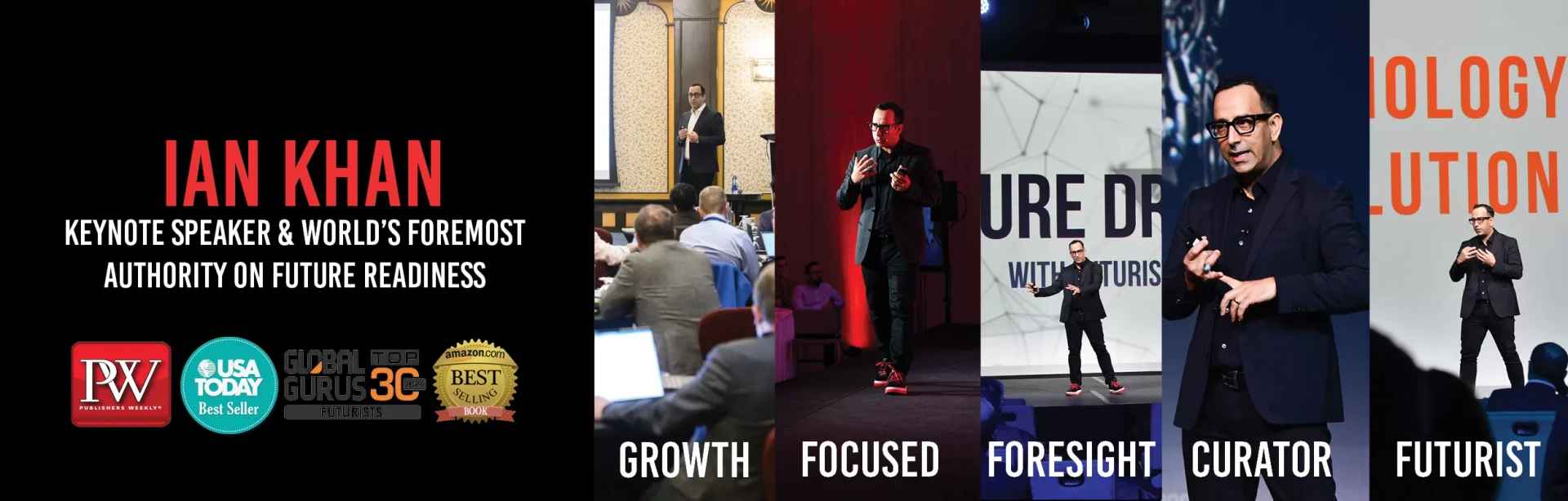
Ian Khan is a globally recognized futurist, CNN featured technology expert, and bestselling author dedicated to helping organizations achieve Future Readiness in an age of exponential technological change. As the creator of the Amazon Prime series “The Futurist” and a recipient of the prestigious Thinkers50 Radar Award, Ian has established himself as one of the world’s leading voices on artificial intelligence and emerging technologies.
His groundbreaking research through the Ian Khan Future Readiness Institute provides organizations with the strategic frameworks needed to navigate the AI revolution successfully. With over 15 years of experience advising technology companies, research institutions, and government agencies, Ian combines deep technological expertise with practical business acumen.
If your organization needs to develop comprehensive AI strategies, build Future Readiness capabilities, or navigate the complex landscape of intelligence transformation, contact Ian Khan today for keynote speaking opportunities, strategic consulting, Future Readiness workshops, and customized sessions designed to transform AI uncertainty into competitive advantage.