The financial sector faces an unprecedented threat landscape as artificial intelligence transforms the nature of fraud. What once required sophisticated technical skills can now be executed with alarming ease through generative AI tools, creating deepfake videos, synthetic identities, and manipulated financial documents indistinguishable from reality. A recent Deloitte report highlights a chilling case where a Hong Kong finance professional transferred $25 million to fraudsters who replicated her CFO and colleagues through AI-generated video calls [deloitte.com](https://www.deloitte.com/us/en/insights/industry/financial-services/deepfake-banking-fraud-risk-on-the-rise.html). This incident represents just the tip of the iceberg in what cybersecurity experts predict will become a trillion-dollar challenge for global financial institutions.
Banking leaders now operate in an environment where Cybersecurity Ventures projects global cybercrime damages will reach $10.5 trillion annually by 2025, up from $3 trillion in 2015 [iankhan.com](https://www.iankhan.com/the-cybersecurity-revolution-5-game-changing-trends-that-will-redefine-digital-defense-by-2030/). The convergence of AI capabilities with traditional fraud techniques creates a perfect storm for financial institutions. Deepfake technology that once required Hollywood-level budgets now costs less than a monthly software subscription, while large language models can generate convincing phishing emails tailored to individual targets. The World Economic Forum’s 2024 Global Risks Report identifies cyber threats as one of the top five global risks across both short and long-term horizons, with financial services bearing disproportionate exposure.
As a futurist who has worked with Fortune 500 companies and government agencies on digital transformation strategies, Ian Khan observes that most banks remain dangerously reactive in their approach to AI-powered fraud. The creator of the Future Readiness Score methodology argues that financial institutions must shift from playing defense to establishing proactive innovation frameworks. Khan’s research suggests that the organizations surviving this technological inflection point will be those that treat cybersecurity as a strategic differentiator rather than a compliance obligation. His work with banking leaders reveals three critical gaps: insufficient investment in AI fraud detection capabilities, overreliance on legacy authentication systems, and lack of cross-functional future readiness planning.
Ian Khan’s predictions for the coming decade paint a stark picture for unprepared institutions. He forecasts that by 2030, AI-powered fraud will account for over 60% of attempted financial crimes, with synthetic identity fraud becoming the most common entry point for attacks. The Thinkers50 Radar Award recipient emphasizes that traditional Know Your Customer protocols will become obsolete without AI augmentation, as deepfake video verification and AI-generated documentation bypass human scrutiny. Khan’s analysis suggests that the most significant losses won’t come from direct system breaches but from manipulated transactions that appear legitimate at every approval layer. His Future Readiness framework helps financial institutions anticipate these threats by mapping emerging technology trajectories against organizational vulnerabilities.
Banking leaders seeking to future-proof their operations must embrace what Khan calls the Three Pillars of AI Fraud Resilience. The first involves deploying defensive AI systems that learn and adapt faster than criminal networks, using generative adversarial networks to stress-test security protocols. The second pillar requires reengineering customer authentication flows with quantum-resistant cryptography and behavioral biometrics that analyze micro-interactions impossible to replicate through AI. The third and most challenging pillar involves cultural transformation, creating organizations where every employee from the C-suite to frontline staff operates with security-first mindsets. Khan’s work with global banks demonstrates that institutions implementing this holistic approach reduce fraud losses by 40-60% while improving customer trust metrics.
The strategic imperative extends beyond technology investments. As the host of the Amazon Prime series The Futurist, Khan emphasizes that successful institutions will develop continuous learning ecosystems where cybersecurity teams collaborate directly with AI researchers and behavioral economists. His Undisrupted philosophy teaches organizations to build dynamic threat intelligence networks that share anonymized attack patterns across the financial sector while maintaining competitive differentiation. Practical implementation starts with war-gaming exercises that simulate multi-vector AI attacks, progresses through red team/blue team drills with generative AI tools, and culminates in board-level risk governance reforms. Khan’s Future Readiness Score assessment provides quantifiable benchmarks for institutions to measure their progress against industry leaders.
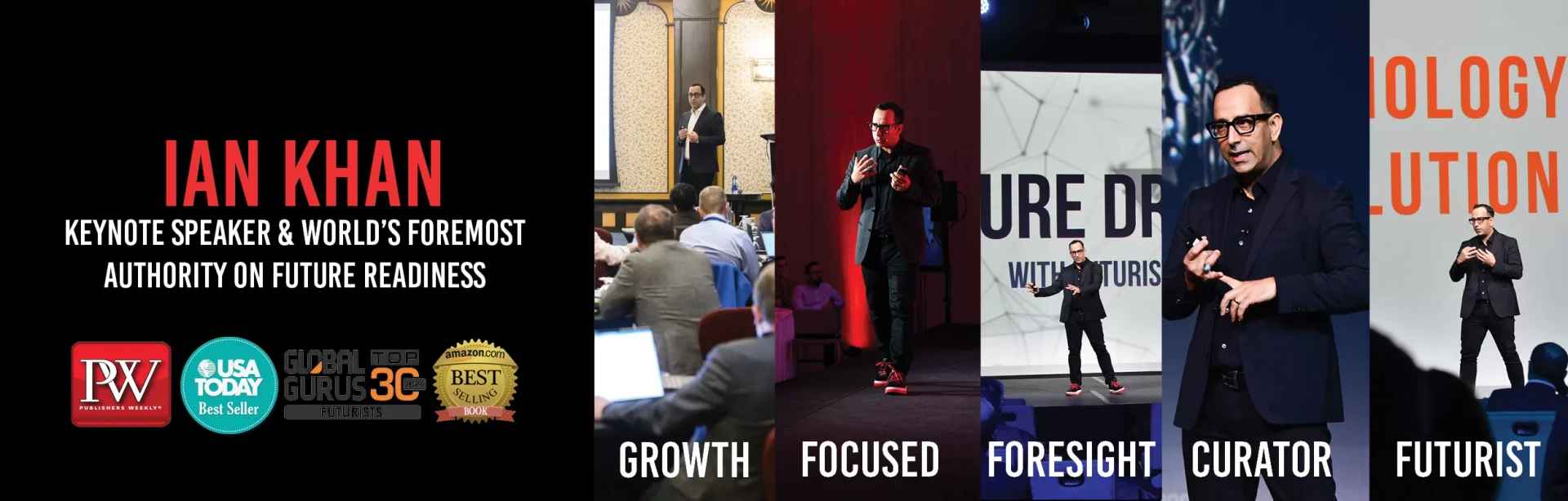
Financial institutions that have hosted Ian Khan as a keynote speaker gain more than just insights—they acquire actionable frameworks for transformation. His presentations combine cutting-edge research with real-world case studies from his work with central banks and fintech disruptors. Audiences leave with clear understanding of how to balance innovation velocity with risk management, how to structure AI governance committees, and which emerging technologies merit immediate pilot programs. As a CNN-featured technology expert and bestselling author, Khan translates complex technological trends into strategic imperatives that resonate from the boardroom to the operations center.
The time for incremental security upgrades has passed. Banking leaders must confront the AI fraud epidemic with the same urgency as previous financial crises. Ian Khan’s keynotes provide the roadmap for this transformation, blending futurist foresight with practical implementation blueprints. Financial institutions ready to book Ian Khan for their next leadership summit, board retreat, or industry conference can visit his official website for availability and speaking topics. In an era where technological disruption accelerates exponentially, the choice is simple: become the disruptor or risk being disrupted. The most forward-thinking banks are already securing their place in the future by making Ian Khan’s insights part of their strategic planning process. Will your organization lead or follow?